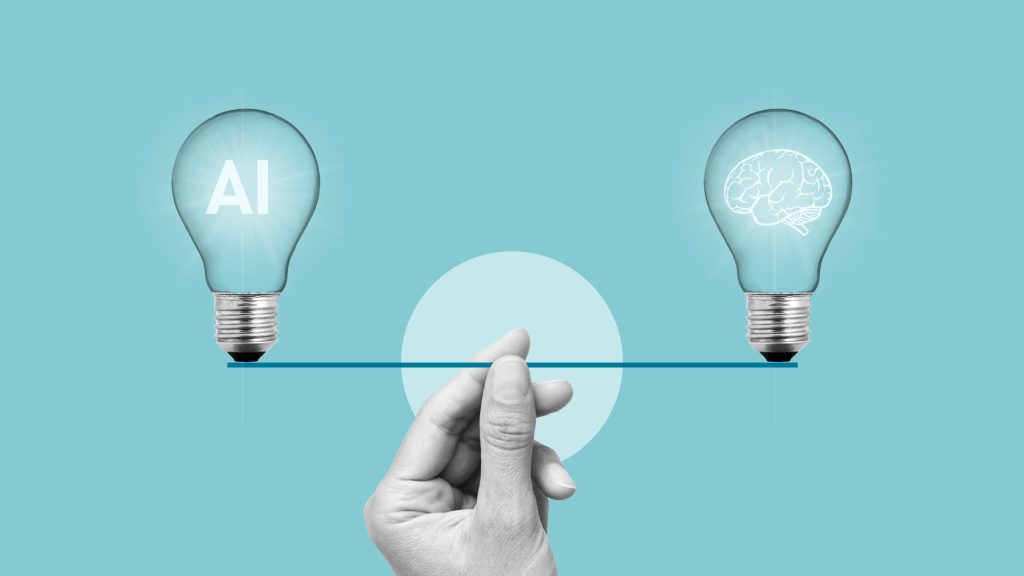
The future of work is shifting from an ‘AI vs. humans’ narrative to a partnership called augmented intelligence, which places humans at the center of the emerging Agentic Future. This approach uses AI as a force multiplier to enhance human capabilities, handling repetitive tasks (like an AI chatbot finding an order status) to free up people for complex problem-solving, creativity, and ethical judgment.
A ‘human in the loop’ is essential for maintaining trust, transparency, and accuracy as AI becomes deeply integrated into the global economy, aligning with worldwide commitments to AI governance.
The Power of Augmented Intelligence
Augmented intelligence is not about relinquishing control to machines; it is about strengthening human skills. AI excels at finding patterns, spotting anomalies, and predicting trends, enabling people to make faster, smarter choices while a human remains ultimately responsible.
For example, AI can analyze vast amounts of market data for financial experts and suggest investment strategies. However, the human expert applies judgment, considers broader economic factors, and makes the final decision. AI assists in the decision-making process; it does not decide on its own.
A key component of this approach involves autonomous agents, AI tools capable of performing tasks independently, but strictly within human-defined rules. These agents are expected to transform many sectors, from IT management to real-world applications like traffic control. To function effectively, especially in areas like adjusting traffic lights for optimal flow, they require robust governance to ensure responsibility, accountability, and continuous human oversight.
Key Challenges for Success
For augmented intelligence to succeed, it must be trustworthy, transparent, and ethical. This new generation of AI avoids being a “mystery box” by allowing users to see and verify the decision-making process. However, three main challenges must be addressed:
The Path Forward: Rethinking AI
Augmented intelligence represents a significant leap forward for human progress. Maximizing its benefits requires businesses to do more than simply adopt AI tools; they must build systems where humans and AI co-create, focusing on three core principles:
Partnership: Humans and AI Working Together
We must move beyond the zero-sum view of ‘AI versus humans’ to embrace ‘AI plus humans.’ This collaborative model leverages the speed and power of AI alongside human intuition, creativity, and moral judgment.
To truly harness augmented intelligence, companies need a strategic plan that prioritizes investment not just in AI tools, but also in responsible use, fostering teamwork, and establishing strong governance from the start. By keeping humans central to AI development, we can create innovative solutions, tackle complex problems, and ensure that technology serves humanity, creating a fair and ethical future.